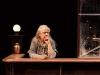
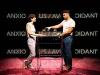
 Left - Anna James and Chad Richards
Push Up is a tedious play. If ever there was a play that skimmed and skidded across the surface of its subject, dipping the odd toe in, without ever even looking like risking immersion, it's Push Up. Yeah, we get it. It's about something to which practically all of us, to some degree or other, can relate. Corporate life; such as there is life once one enters that realm. It's about the desperation and paranoia that tends to ensue, once one steps onto the treadmill. The rivalry. The sublimation of real human needs and desires. The feigning of confidence to disguise gaping insecurities. Yada. Yada. Yada. To that extent, it has value. The problem is, it doesn't really tell us anything we don't already know. There's no epiphany. No 'ahh!' moment. No nothing.
Roland Schimmelpfennig is a tedious playwright; if a prolific one (he's 43 and has written 26 plays). At the risk of cultural stereotyping, there is a dry, cold, Teutonic uniformity endemic to his writing that mitigates against the seething emotions he seeks to discover. There's an almost obsessive concern with structural symmetry, with demonstrating his own cleverness in this respect, that detracts from character development and exposition; narrative; plotting. To give it its due, the almost verbatim repetition of asides from 'opposing' characters works well, in principle, and inasmuch as spotlighting the comical irony of common ground between people who've come to see themselves as somehow essentially, fundamentally, different; in proving consonance, where they see only dissonance. Yet, in practice, said repetition bespeaks the very tedium of which I complain. Had the playwright more imagination and wit, he would've capitalised on the obvious opportunity to create characters with palpable similarities, yet differentiated and individuated in ways that would make them both believable and interesting. For example, we don't need two female characters that eat only fruit for breakfast. One could exemplify such discipline, while the other could express her intention to do so, even while dipping pain au chocolat in her coffee. It's not literary rocket surgery. Thus, to describe this play, as has been done, as 'dealing with the loss of humanity within the battleground of the corporate world' enobles and elevates it high above its status.
Nicole Selby is a promising director who was awarded the Order of Australia Emerging Director’s Grant in 2008 and even more recently assisted Sandra Bates, at Ensemble, with McReele and Mark Kilmurry, with Animals Out of Paper. But this play needed, and needs, to be cranked. Lines are delivered, for the most part, with painful, almost patronising, deliberation.
Selby has sought to intellectualise the play way beyond its station, too, in quoting the likes of Henry David Thoreau, who said, with characteristic eloquence and perspicacity, 'the price of anything is the amount of life you exchange for it'. While the work succeeds in pointing to the pointlessness and mock grandeur of the contest, it reveals nothing new, unknown or surprising. As such, it succumbs to a pitiable irony: it is almost pointless in itself. Moreover, call me cynical, but there is a kind of neatness and naivety to the notion that we're all much the same under the skin; move past the affectations of ambition, the postures of power, and we'll discover we can all be friends. This plays into the kind of delusional elevation of the human species to a rarefied moral plane that Darwin railed against. We're as competitive as we are collaborative. We befriend. But we also savage. We are savages. And, often, all too often, not half as noble as we'd prefer to believe. Get over it. It's telling, too, that Schimmelpfennig seems to see himself as completely outside, and above, the grasping, sexually-tense, gladiatorial quest for glory. Anyone who's sat back just a little would be able to see, in stark relief, a similarly corrupt, mediated and politicised scenario pervading the realm of theatre. In striving to be coolly ironic, the author emerges (obliviously, it seems) looking, ironically, uncool.
While the cast are all professional actors with numerous stage, television and film credits (all are Ensemble Studios graduates), all performances were undercooked, with numerous stumbles and even one or two 'crossed words'. Worse still, too many seemed unsure of their lines; in one or two cases, one could almost see the mind whirring, in near panic. Were it a dress rehearsal, or even preview, this might be ok. On opening night, I'm still prepared to cut some slack, but this level of preparation, or lack thereof, is unacceptable. And unprofessional. And, in a way, it's all the more disappointing given the heritage and aspirations of the company; formerly The Rep, set up by Sandra Bates way back in '83, newly-named Hayes Gordon Rep (HGR) Theatre. On this evidence, it's certainly not living up to that name. And when one takes on board artistic director Clayton Buffoni's rather pretentious statement that 'HGR is dedicated to producing work that examines the human element of conflict on both social and political levels', one has a right to expect higher standards, especially for a company that's been hovering for going-on 20 years. Of course, in this market, longevity is an achievement in itself, so one can only assume the company is capable of much better and this is atypical. Otherwise, it's a severe indictment on funders, fans and critics alike.
Tamar Cranswick, it has to be said, gives good distress, as Sabine, a capable, ahead-of-the-game aspirant for a coveted overseas posting who, in need of notoriety, embraces an untrue allegation of sleeping with her boss. Weird. I see these actors as victims and prisoners of often inscrutable, confusing, directionless, meaningless dialogue. Schimmelpfennig has made their job harder still, in constructing characters who aren't merely neurotic, like the rest of us, but borderline psychotic.
Ruth Caro, as head honchette, Angelica, is as convincing as she can be, given the misogynistically unidimensional shallowness with which Schimmelpfennig has construed his corporate women.
Chad Richards, as Robert, doesn't seem nearly as confident, convinced, or convincing. But who can blame him. Anna James, as Patrizia, object of his desire, is about equally at sea.
Chris Lewis, as elder exec Hans, apart from being dressed absurdly, in checked shirt and sleeveless pullover, to say nothing (the less, the better) of unspeakable shoes, was a charismatic presence but, again, lines were delivered with almost didactic declamation, rather than naturalness. Hans is running for his life, while his younger nemesis, Frank, isn't far behind. Lynden Jones put in the best performance, by quite a margin, of all, with Stephanie Pick's charming security guard cameo running a close second (she seemed wasted in this minor role).
A couple of things that work: Tom Bannerman's set design is cold, hard, industrial and prison-like. It fits like a glove, though is let down by tired, sub-executive furniture that doesn't mesh; eccentrically, impossibly futuristic items would've been de rigueur. Jocelyn Speight's lighting design is, however, very companionable and complementary to Bannerman's vision.
Maja Zade did the translation, in which, I suspect, little was lost. Then again, who knows? I'm almost tempted to have my translator friend conduct forensic linguistic verification. It's reasonable to allow for idiomatic and cultural variations. But I don't think any amount of generous erring in deference to such can redeem this play from my low estimation of it; notwithstanding my relative Robinson Crusoedom in heroically adhering to such an evaluation of play and playwright. But, of course, you might disagree. I respect your right to do so. My companion did. Heartily. He found it both entertaining and satisfying. And, after all, as one of the play's characters cogently postulates, two people can be in the same room and see completely different things.
Hayes Gordon Rep presents
Push Up
by Roland Schimmelpfennig | translated by Maja Zade
Director Nicole Selby
Venue: Newtown Theatre | Cnr King & Bray Sts, Newtown South
Preview: 15 June
Dates: Wed June 16 - July 10, 2010
Times: Tuesday – Saturday, 8pm
Tickets: $28 Full, $22 Concession, ($10 Tues available at the door).
Bookings: 02 8507 3034 | www.newtowntheatre.com.au